


There is no single best metal for every custom engagement ring. Platinum suits a buyer who prioritizes a white appearance that comes from the metal itself and a substantial feel, while 14K gold offers practical everyday versatility and 18K gold provides a richer gold direction. Choose based on your wear habits, preferred colour, comfort, maintenance expectations, and budget, then confirm the exact alloy and finish in the custom quote.
The short answer: choose by your priorities
Start with five questions: How often will the ring be worn? Do you prefer white, yellow, or rose colour? How should the ring feel on the hand? What maintenance are you comfortable with? What budget needs to cover the complete ring, including the stone, setting, design, and finishing?
For a ring worn every day, the design itself matters as much as the material. Band width, setting architecture, stone size, ring profile, alloy composition, and your own habits all affect comfort and visible wear.
Platinum, 14K gold, and 18K gold compared
Platinum, 14K gold, and 18K gold can all work for a custom engagement ring, but they solve different priorities. Compare the complete custom quote instead of choosing from the metal name alone.
| Option | Colour and composition | Everyday-wear considerations | Maintenance and feel | Often suits |
|---|---|---|---|---|
| Platinum | White in its natural state; not a gold alloy | A substantial precious-metal option for daily wear; develops a characteristic surface patina as it is worn | Usually feels heavier than a similar gold design; surface appearance can change with wear | Someone who wants a white appearance and solid feel |
| 14K gold | 58.3% gold, combined with other metals; available in white, yellow, and rose | A practical starting point for frequent wear, with the final experience shaped by the alloy and construction | Often balances gold content, wear considerations, and budget; white gold may involve a surface finish | Someone balancing everyday practicality and budget |
| 18K gold | 75% gold, combined with other metals; available in white, yellow, and rose | Provides a greater share of gold and a richer gold direction | Can feel more precious and colour-rich; confirm care and servicing terms | Someone who values gold content and richer appearance |
These are useful starting points, not guarantees. A narrow ring with delicate details behaves differently from a wide, low-profile band, even when both use the same metal.
Choose the metal by the way you will wear the ring
Choose platinum if a white appearance is your priority
Platinum is a strong starting point if you want a white appearance that comes from the metal itself instead of from a gold-colour alloy. Its substantial feel may appeal to someone who prefers a solid ring.
Ask how the proposed platinum design will be finished and serviced over time. Platinum can develop a visible patina as the surface changes with wear.
Start with 14K gold if everyday practicality and budget are central
14K gold is a sensible first option if you want a gold ring for frequent wear while keeping more of your budget available for the stone, setting, band details, or future pieces. It contains less gold than 18K gold, but the final ring still depends on its alloy, dimensions, construction, and finish.
Consider 18K gold if gold content and colour matter most
18K gold may suit you if you want a larger proportion of gold and a richer yellow-gold direction. Discuss daily use, band dimensions, setting, finish, and servicing before deciding that this option is worth the difference in the complete quote.
Karat, colour, and Canadian quality marks are different things
Karat describes the proportion of gold in a gold alloy. It does not tell you whether the ring is white, yellow, or rose gold. Those colours come from the other metals blended with gold and, for some white-gold designs, the surface finish applied afterward.
In Canada, the Competition Bureau states that gold quality marks may range from 9K to 24K and must meet prescribed quality and tolerance requirements. Read the Canadian precious-metal marking requirements to understand how a stated gold quality mark relates to the represented metal.
- The metal: platinum or gold, not just a colour description.
- The karat if the ring is gold, such as 14K or 18K.
- The colour: white, yellow, or rose.
- Whether the stated colour depends on plating or another surface finish.
- The quality mark or documentation included for the individual piece.
- Any care, refinishing, repair, or replating terms.
Match the colour to the ring design and your existing jewellery
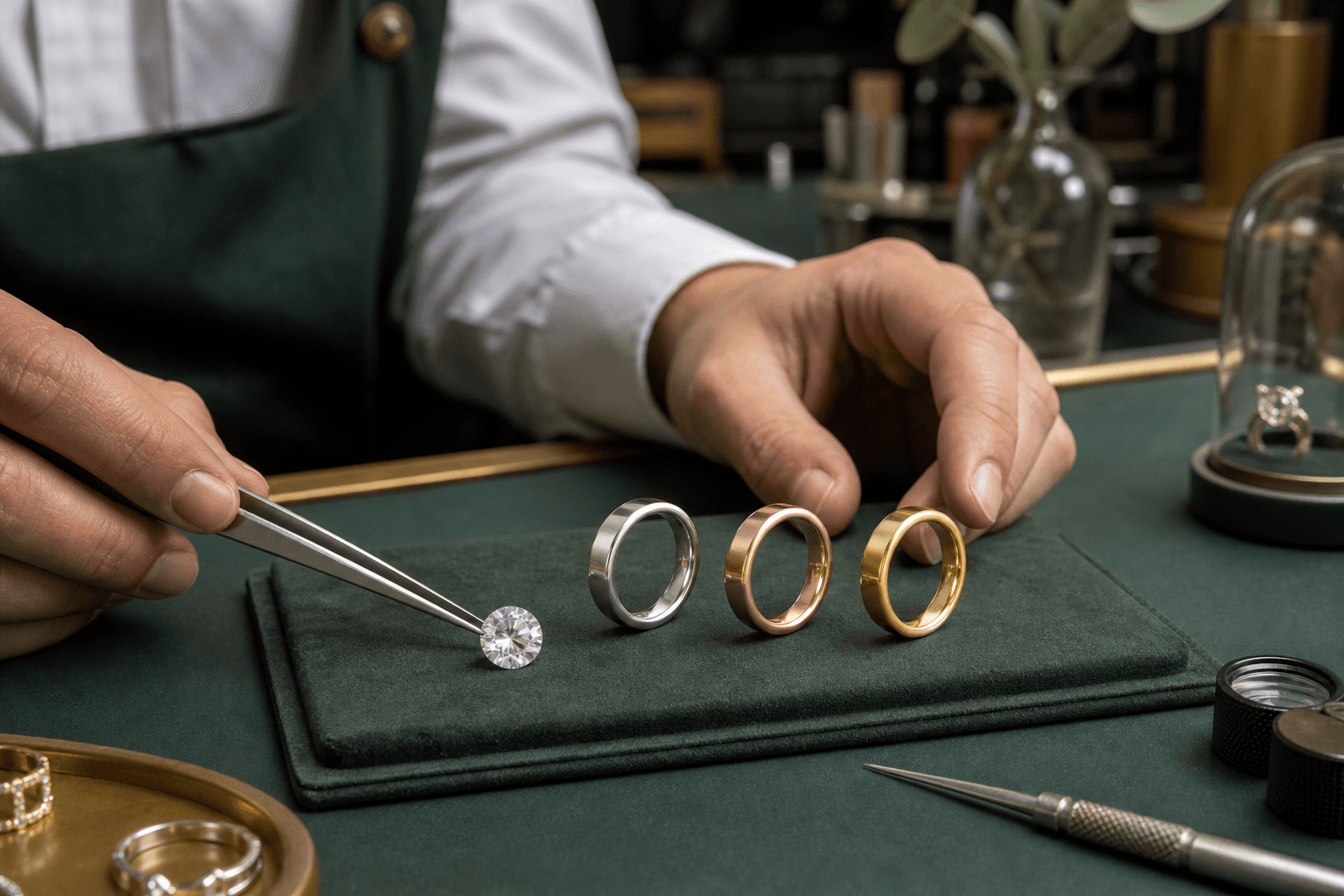
White gold and platinum create a cooler, bright-metal direction. Yellow gold adds warmth, while rose gold introduces a softer pink-toned contrast.
Look at the whole design, not only a metal sample. The stone's colour, setting shape, band profile, finish, and wedding band all affect the result.
If you already wear yellow-gold earrings or a watch, yellow gold may create a more connected wardrobe. If most of your jewellery is white metal, platinum or white gold may feel more consistent. A mixed-metal concept can be discussed, but ask how each metal will be finished and serviced.
Turn your preference into a custom-ring brief
A useful brief turns “I want a timeless ring” into decisions a designer can review. Before requesting a quote, write down:
- Metal and karat: Begin with platinum, 14K gold, or 18K gold, then state whether you prefer white, yellow, or rose gold.
- Daily use: Explain whether the ring will stay on most of the time, be removed for work or exercise, or be worn mainly for occasions.
- Ring size and comfort: Provide your current size if known and describe whether you prefer a slim, substantial, rounded, or low-profile band.
- Stone identity: State whether you are considering a natural diamond, lab-grown diamond, moissanite, or another gemstone, and ask what documentation accompanies it.
- Setting and structure: Ask how the selected metal works with the setting, stone dimensions, band width, and accent stones.
- Colour and finish: Specify polished, brushed, mixed, or another finish after discussing its appearance.
- Budget range: Give a complete-ring range and ask what it includes, including design work, metal, stone, setting, finishing, taxes, shipping, and other charges.
- Future service: Ask about resizing, repairs, refinishing, replating where relevant, and the conditions for each service.
- Delivery and returns: Confirm delivery arrangements and custom-order terms before payment or production.
Before choosing between platinum, gold, or another material, review the custom jewelry process to understand how your preferred material fits the ring's design and production stages.
How the choice fits an Advikosh custom design
Advikosh is a Canadian luxury jewelry brand specializing in custom jewelry, natural gemstones, diamonds, lab-grown diamonds, moissanite, and handcrafted fine jewelry. During a Brampton consultation, ask whether your preferred metal and design direction fit the intended piece.
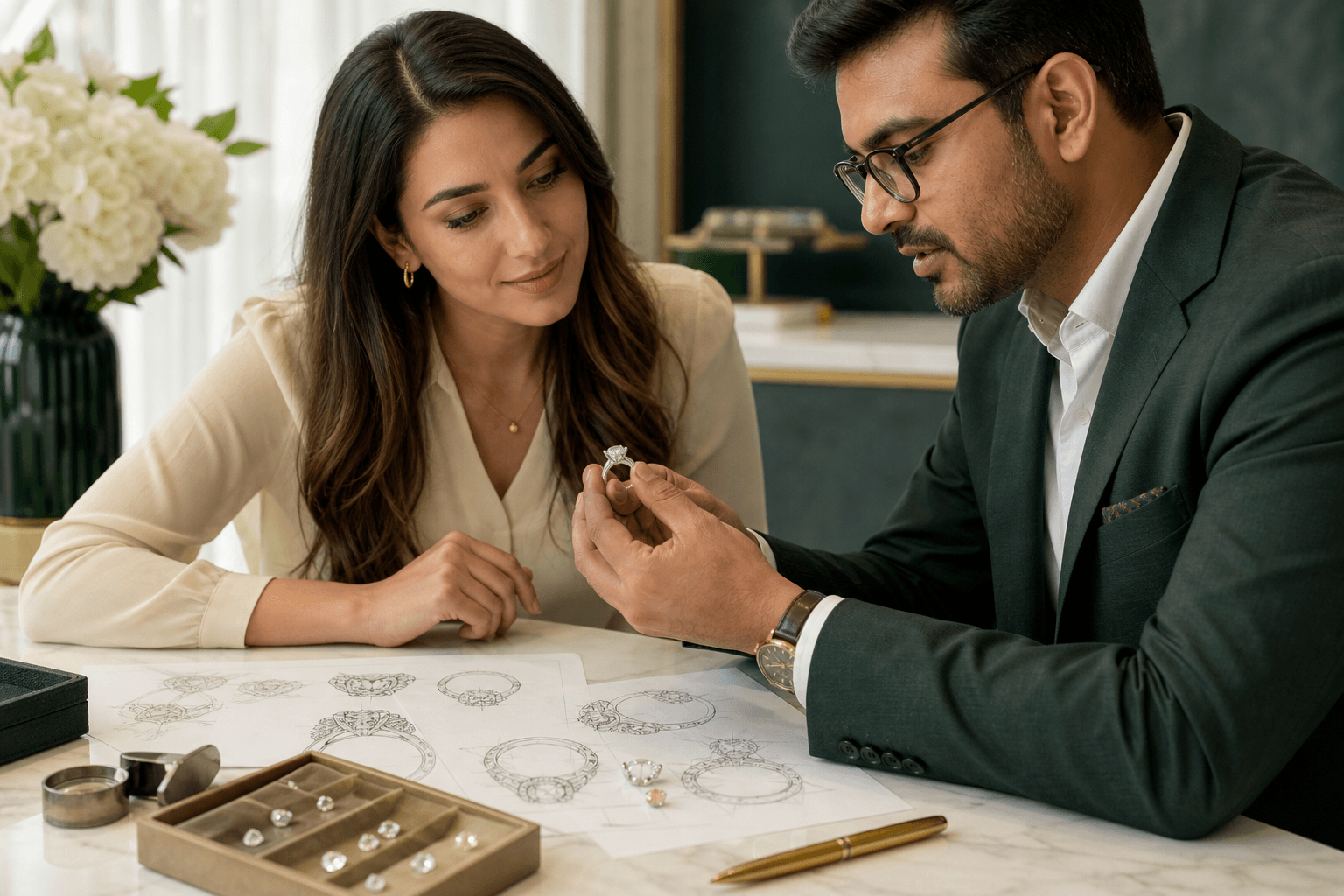
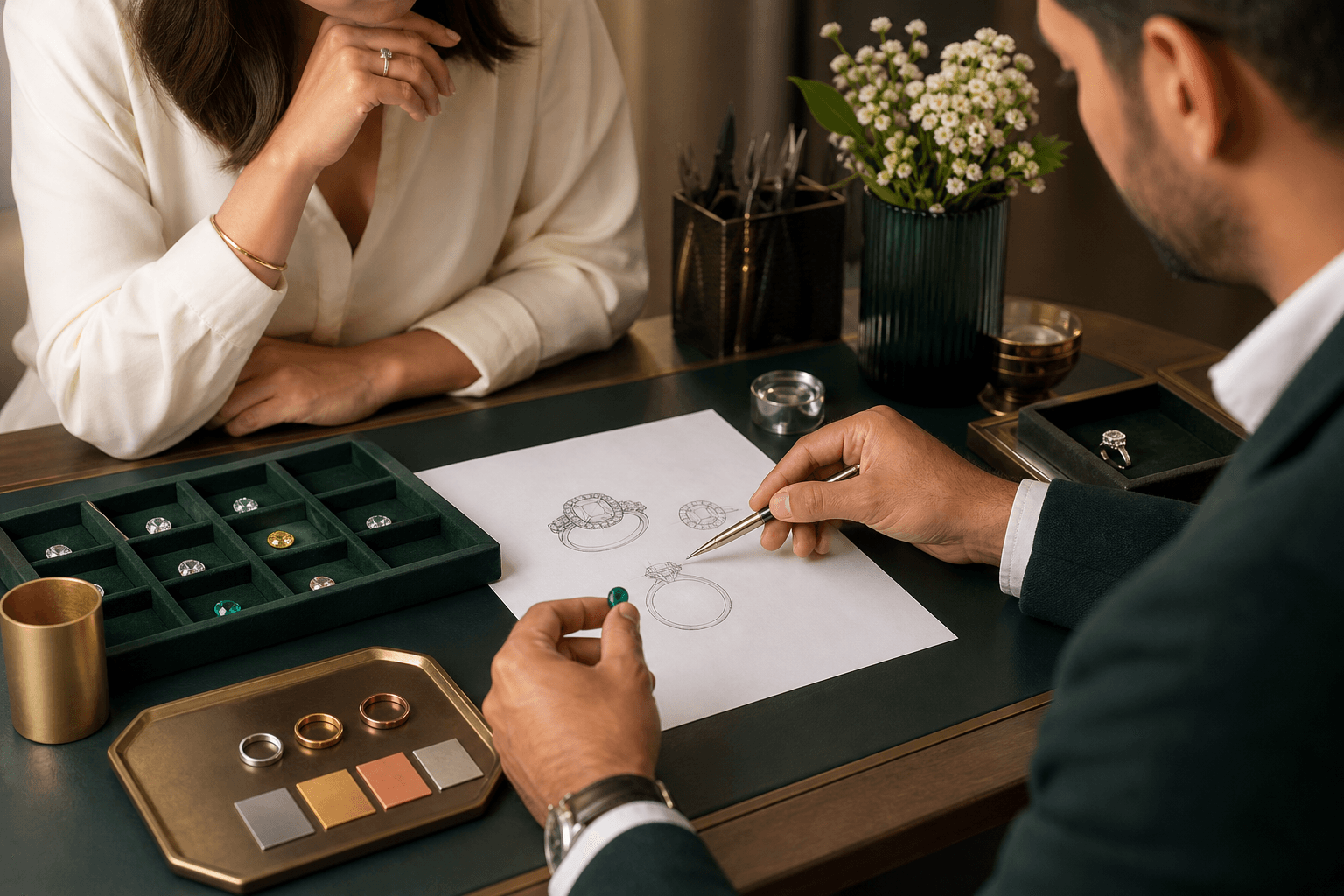
You can bring an idea, sketch, or photo into the conversation. Advikosh's stated custom process includes approving the design before production begins, giving you a point at which to verify the metal, colour, dimensions, setting, and other agreed details.
Questions to settle before you approve production
- What exact metal and karat will be used?
- For white gold, what finish is applied, and what maintenance does it require?
- How will the selected alloy affect weight, profile, setting, and appearance?
- What stone identity, dimensions, colour, and documentation are included?
- What ring size, band width, thickness, and profile are shown?
- Can the ring be resized later, and are there design limits?
- What does the complete quote include?
- What care, repair, refinishing, or replating support applies?
- What documentation or authenticity information accompanies the piece?
- What are the delivery and custom-order return or exchange conditions?
Keep the approved metal description and design details with your quote. If the conversation uses phrases such as “white metal,” “premium gold,” or “durable finish,” ask for the precise material, karat, colour, and treatment.
Frequently asked questions about engagement-ring metals
Is platinum always the best metal for an engagement ring?
No. Platinum is one option for someone who wants a white appearance and substantial feel, but the right choice also depends on lifestyle, preferred colour, maintenance, and the complete-ring budget.
Is 14K or 18K gold better for a custom engagement ring?
Neither is universally better. Compare the gold proportion, alloy, colour, construction, care needs, and complete quote against the way you expect to wear the ring.
What should I ask about metal choice before approving a custom ring?
Ask for the exact metal, karat, colour, finish, dimensions, stone and setting details, care terms, future resizing or repair options, documentation, delivery arrangement, and custom-order conditions.
Choose the metal that fits the wearer
The best starting metal is the one with a clear reason behind it. Match your choice to the wearer's habits, preferred colour, comfort, maintenance expectations, and complete-ring budget, then carry those decisions into design approval.
For a Brampton custom engagement-ring project, explore Advikosh's custom jewelry service with your preferred metal, colour, stone direction, and questions ready for review.