


A ring needs professional assessment when it repeatedly slips, spins, pinches, causes discomfort, or is difficult to remove. Measure on the correct finger under normal conditions, then have the ring and its construction assessed before authorizing work because width, settings, stones, engraving, plating, and design can change what is practical. The right solution may be resizing, a temporary sizing aid, redesign, or a complete remake.
This jewelry resizing guide helps you choose the safest next step without assuming that every ring should be altered.
In this guide
- How to recognize a genuine fit problem
- How to choose between resizing, adjustment, redesign, and remake
- How to measure your ring more reliably
- Which ring designs need extra caution
- What professional resizing involves
- Risks and possible side effects
- How to plan and compare a quote
- How to prepare before handover
- How to check the finished work
- Frequently asked questions
Ring Fit Signs That Point to a Real Problem
A correctly fitting ring should clear the knuckle with modest resistance, sit comfortably at the base of the finger, and come off comfortably. It should not repeatedly spin, slide off during ordinary movement, or leave persistent pressure, numbness, or pain.
Signs a ring is too loose
- The ring turns around the finger often, especially if the setting is heavy.
- It moves toward the fingertip during normal activity.
- It comes off when you wash your hands or make a relaxed fist.
- You are constantly checking whether it is still there.
Signs a ring is too tight
- It leaves a deep, lasting indentation after removal.
- It is difficult to clear the knuckle or remove without soap and force.
- Your finger feels pressured at rest, not only after exercise or heat.
- It causes ongoing discomfort or restricts normal movement.
Heat, exercise, salt, cold, time of day, and temporary swelling can affect fit. Your dominant hand may also differ slightly from the other, and a wide band usually feels tighter than a narrow band in the same nominal size.
A ring that feels different for an hour after exercise does not automatically need permanent resizing. A persistent problem across several ordinary days is a stronger reason to seek an assessment.
Choose the Right Solution: Keep, Resize, Adjust, Redesign, or Remake
Resizing is only one possible answer. The best option depends on how large the fit problem is, whether it is consistent, how the ring is built, and whether preserving the original design matters more than changing its structure.
- Keep the ring as it is if the fit is comfortable most of the time and the change is linked to temporary heat, cold, or activity.
- Use a temporary aid if the ring is slightly loose, you need to wear it briefly, or a permanent decision needs to wait for assessment.
- Resize smaller if the ring consistently slips and its shank and setting can tolerate a reduction.
- Resize larger if the ring is consistently tight and suitable material and structural flexibility are available.
- Redesign the ring if its proportions, setting, shoulders, or stone arrangement need to change along with the size.
- Remake the piece if the metal is badly worn, the setting is unsafe, the construction cannot accommodate the change, or preserving the design requires a new structure.
A plain band that is one small adjustment away from a comfortable fit may be straightforward to assess. An eternity band with stones around the entire circumference may need another solution because altering one section can affect pattern and stone spacing.
Measure Your Ring More Reliably Before Requesting Work
At-home measurement is useful for an initial estimate, but professional measurement is the better basis for a high-value alteration or new custom ring. A home reading can be affected by finger temperature, pressure, ring width, and knuckle shape.
A more reliable home method
- Measure the exact finger and hand where the ring will be worn.
- Take readings at least twice during the day, including once at normal indoor temperature.
- Measure when you have not just exercised or spent time in extreme cold or heat.
- Use a ring-sizing tool if available. For an existing ring, compare its inside diameter with a reliable chart.
- Do not pull paper or string tightly around the finger. Tight wrapping can produce an undersized result.
- Record the readings, time, finger, hand, and whether the ring is narrow, wide, flat, or heavily shaped.
Paper and string methods can identify a rough range, but thickness and tension introduce error. A wide band may need a different comfort approach from a narrow band even at the same nominal size.
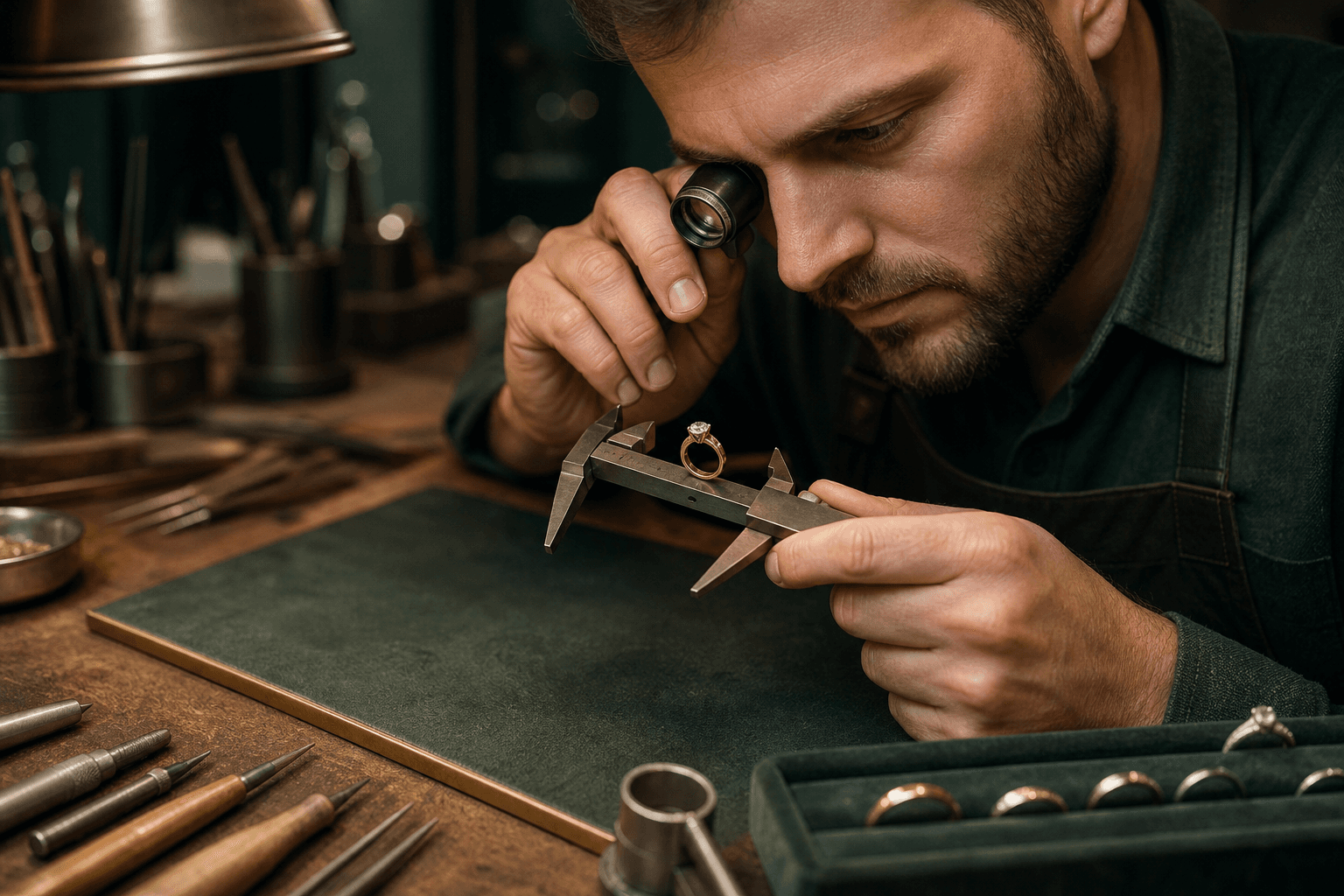
Before ordering a custom ring or authorizing a meaningful alteration, arrange professional measurement and inspection of the actual ring. Its inner profile, shoulder shape, setting, and intended position can affect practical fit.
Which Rings Can Be Resized and Which Need More Caution?

Whether a ring can be resized depends on its material, construction, stone placement, condition, and requested change. There is no universal safe adjustment limit, so the piece should be inspected first.
| Ring type | Typical assessment | What may require attention | Possible alternative |
|---|---|---|---|
| Plain metal band | Often simpler to assess | Roundness, seam visibility, thickness, finish | Temporary aid or new band |
| Solitaire ring | Often more adaptable than a full eternity band | Setting alignment, symmetry, stone security | Reshape or redesign |
| Eternity band | High caution | Stone spacing, pattern continuity, setting pressure | Temporary aid, open-band redesign, or remake |
| Pavé band | Requires close inspection | Loose stones, disturbed beads, uneven spacing | Redesign or remake |
| Halo ring | Possible in some cases | Alignment, security, shoulder stress | Structural redesign |
| Tension setting | Highly dependent on engineering | Metal tension, stone security, alignment | Remake or redesigned setting |
| Engraved band | May be adjustable | Interrupted lettering or altered spacing | Re-engraving or redesign |
| Intricate shoulders | More difficult than a plain shank | Pattern continuity and symmetry | Redesign |
| Plated ring | Needs finish assessment | Joining, polishing, and refinishing may affect plating | Refinish, replate where appropriate, or remake |
| Vintage or inherited ring | Condition is critical | Thin areas, repairs, worn settings, unusual alloys | Stabilization, redesign, or documented remake |
These categories are starting points, not approvals. A simple-looking ring can have hidden thinning or previous repair, while a complex ring may be adaptable after detailed review.
For broader design decisions, prepare the wearer’s preferences, intended use, material priorities, and reference images. The custom jewelry design preparation guide can help organize those choices.
How Professional Ring Resizing Works

Professional resizing normally starts with inspection and ends with fit, finish, and setting checks. The method depends on the ring, direction and amount of change, metal, and condition.
1. Inspection and documentation
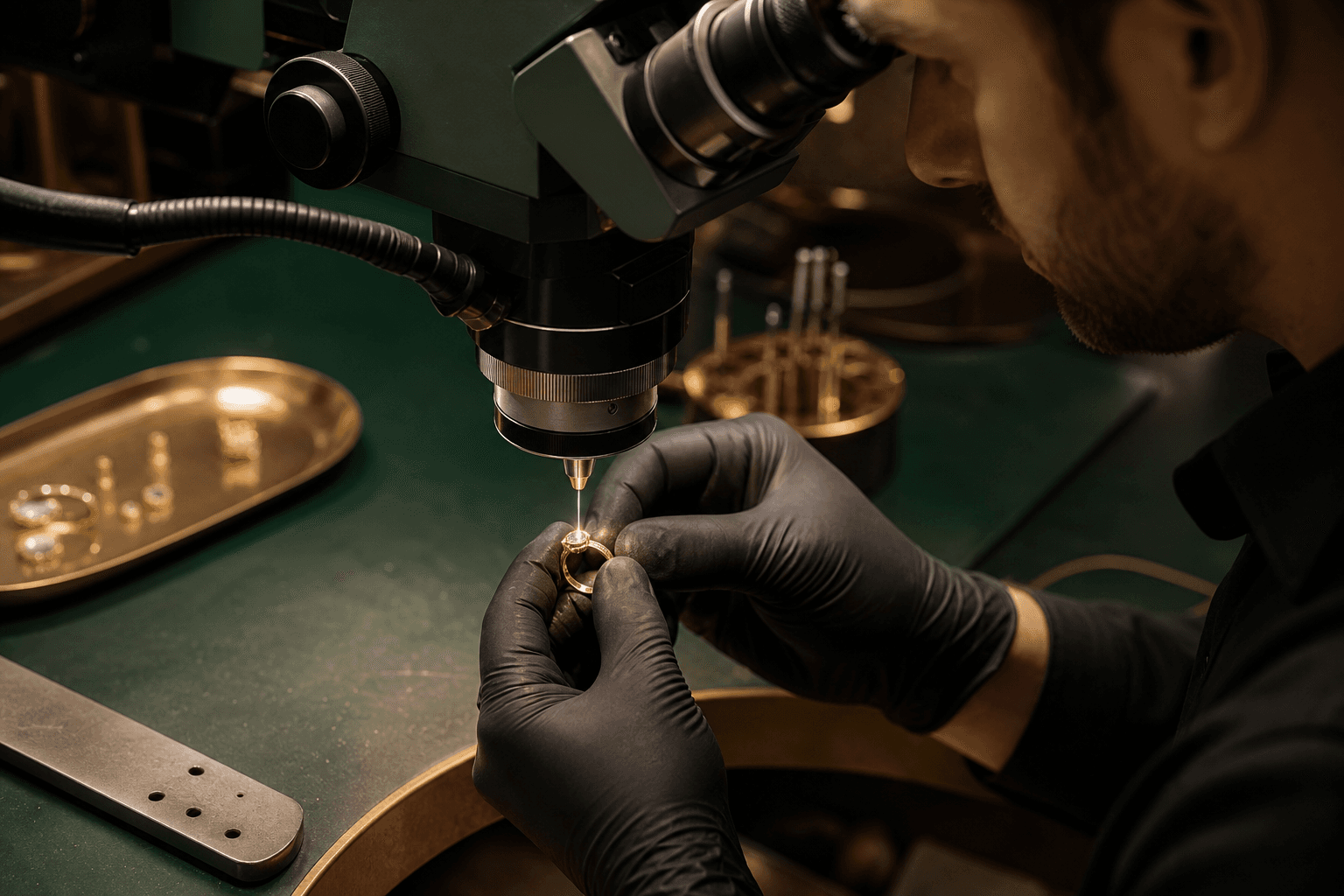
The workshop examines metal, markings, shank thickness, stones, settings, engraving, plating, previous repairs, and visible damage. Photographs and notes record the starting condition and requested size or fit goal.
2. Making a ring smaller
For a suitable ring, a jeweller may remove a section of metal from the lower shank, join the ends, reshape the ring, and refinish the surface. The setting and shoulders must then be checked for balance and symmetry.
3. Making a ring larger
Depending on the design, a jeweller may stretch a limited amount of suitable metal or cut the shank and add a matching section. Alloy, thickness, pattern, stone placement, and requested change determine whether that method is appropriate.
4. Joining, shaping, and finishing
The joined area is worked until the ring is round and even. Filing, polishing, texture matching, engraving, or refinishing may be needed, and plated surfaces may require separate treatment.
5. Final checks
The completed ring should be checked for roundness, symmetry, secure settings, surface quality, stone movement, and requested fit.
There is no reliable universal timeline. A plain ring differs from an engraved, plated, stone-set, vintage, or structurally worn piece, and workload also affects timing.
Risks and Side Effects to Discuss Before Approval
Resizing changes the structure of a ring, so the result may involve more than a different inside circumference.
- Stone security: movement, heat, pressure, or work near a setting can require inspection.
- Setting alignment: a centre stone, halo, or side-stone arrangement can sit differently.
- Shape: the ring can lose roundness without proper reshaping and checks.
- Visible seams: joining and refinishing may leave a line on textured or patterned surfaces.
- Engraving: a cut can interrupt lettering or symbols.
- Plating and finish: joining or polishing can affect surface colour, texture, or patina.
- Shoulder symmetry: intricate details may need adjustment after a substantial change.
In Canada, precious-metal quality-designation marks must meet legal requirements and prescribed tolerances. If only part of an item is precious metal, the relevant part must be identified with the quality mark. See the Competition Bureau’s precious-metal marking requirements.
Ask for precise wording about plated finishes. Canadian rules restrict claims that guarantee plating durability or wear for a period of time. The guide to the Precious Metals Marking Act and Regulations explains this distinction.
Plan the Quote Without Relying on a Universal Price
There is no supported standard Brampton or Canadian price for ring resizing, and no standard turnaround applies to every ring. A useful estimate must reflect the piece and exact work proposed.
- Metal type, purity, colour, availability, and amount removed or added
- Direction and size of the requested change
- Plain, patterned, engraved, pavé, halo, eternity, tension, or shoulder construction
- Stones near the work area, loose settings, worn prongs, or previous repairs
- Re-engraving, texture matching, polishing, refinishing, and plating
- Repairs required before resizing
- Inspection, documentation, shipping, insurance, and follow-up terms
Compare written estimates by scope, not only total. Ask whether inspection, metal, joining, reshaping, polishing, engraving, refinishing, setting checks, shipping, taxes, and separate approvals are included.
Useful questions include: “What size or fit target are you quoting?”, “Which method do you propose and why?”, “What may change visibly?”, “What is excluded?”, and “What happens if the ring still does not fit?”
Engagement, Heirloom, Vintage, and Custom Rings Need Context
Engagement and heirloom rings can sometimes be resized, but sentimental value makes preservation more important than simply reaching a number. Assess worn prongs, thin shank areas, previous repairs, unusual alloys, nearby stones, and fragile decorative details.
A vintage ring may have a softer or less predictable structure than a modern plain band. Document its condition and ask whether stabilization should come before any size change.
Custom rings require an additional discussion about design intent. If resizing would distort proportions, interrupt a pattern, or compromise a setting, redesign or remake may preserve the visual idea more successfully.
Temporary Options and Why DIY Structural Work Is a Bad Trade
A removable ring guard, sizing spiral, or appropriately fitted sizing beads may help with a minor loose-fit problem. These options are useful while waiting for assessment or during seasonal fluctuation, but they do not solve a persistent structural issue.
You may also choose not to wear the ring until its fit and condition have been assessed, especially if it slips, catches on clothing, or contains a stone that appears loose.
Safety note: Do not cut, heat, hammer, stretch, glue, or chemically alter a ring at home. These alterations can affect the ring’s structure, settings, and finish, so a qualified jeweller should assess the piece first.
Prepare the Ring Before You Hand It Over
Before an assessment or handover:
- Photograph the top, underside, sides, setting, engraving, and marks.
- Record scratches, dents, worn areas, loose or missing stones, and previous repairs.
- Note when the ring slips or pinches and whether temperature or activity changes the problem.
- Write down the desired size or comfort goal.
- Record metal markings and known stone details.
- Ask for the method, visible changes, inclusions, exclusions, and approval points in writing.
- Keep insurance, appraisal, and valuation questions separate from the resizing estimate.
Check the Fit and Finish When the Ring Returns
Assess the ring in ordinary conditions. It should fit over the knuckle with controlled resistance, sit securely without persistent pressure, and remain comfortable when your hand is relaxed.
- Does it sit straight and remain stable during normal movement?
- Does it clear the knuckle without force and come off without distress?
- Is the band round, without an obvious flat spot?
- Can you see or feel an unexpected seam, ridge, rough edge, or finish mismatch?
- Is the engraving complete and positioned as agreed?
- Do the prongs and settings look even, with no stone movement?
- Do the centre, halo, pattern, and shoulders remain aligned?
If the ring still feels wrong, or a stone moves, stop wearing it if security is uncertain. Photograph the issue and contact the workshop promptly under the agreed terms.
Three Hypothetical Ring Decisions
The following examples are hypothetical. They show how construction and condition change the recommendation and are not Advikosh customer projects.
A loose solitaire
A plain solitaire consistently rotates and slides, but its stone, prongs, and metal are sound. After professional measurement, a modest reduction or temporary aid may be considered.
An eternity or pavé band that needs expansion
A stone-set band feels tight, but stones or a continuous pattern surround the ring. A temporary solution, open-band redesign, or remake may be more predictable than conventional enlargement.
A worn vintage ring
A vintage ring is tight, has thin areas, and shows setting wear. Stabilization, reinforcement, redesign, or a carefully planned remake may be preferable to resizing first.
Frequently Asked Questions About Jewelry Resizing
How much can a ring be resized safely?
There is no universal safe number of sizes. The practical limit depends on metal, construction, stone placement, setting, engraving, condition, and direction of change.
Can an engagement ring or heirloom ring be resized?
Some can, but age, wear, previous repairs, fragile settings, unusual metals, and sentimental details can change the recommendation.
How much does ring resizing cost in Canada?
There is no single dependable price. Request a written quote separating metal, size change, construction, stones, repairs, engraving, polishing, plating, shipping, taxes, and follow-up work.
How long does professional ring resizing take?
There is no standard turnaround. The ring’s construction, condition, method, finishing, inspection, and workshop schedule affect timing.
Can Advikosh resize a ring I already own?
Advikosh confirms custom jewelry design and fabrication, but its published information does not confirm conventional resizing of an existing ring. Ask about the scope and provide photographs, measurements, and your preferred outcome.
Is it safe to resize a ring at home?
Home structural alterations should not be attempted. Cutting, heating, hammering, stretching, gluing, or chemically altering a ring can affect its structure, settings, and finish, so have a qualified jeweller assess the piece first.
A Practical Next Step for Custom or Redesign Work
If your ring needs more than a straightforward size change, gather photographs, measurements, original design details, and the features you want to preserve. Advikosh’s FAQ states that customers can ask about creating jewelry from their own design, sketch, or photo and approve a custom design before production. For a redesign, remake, or new bespoke piece, explore Advikosh’s custom jewelry service and ask which route fits the ring’s condition and your intended result.