

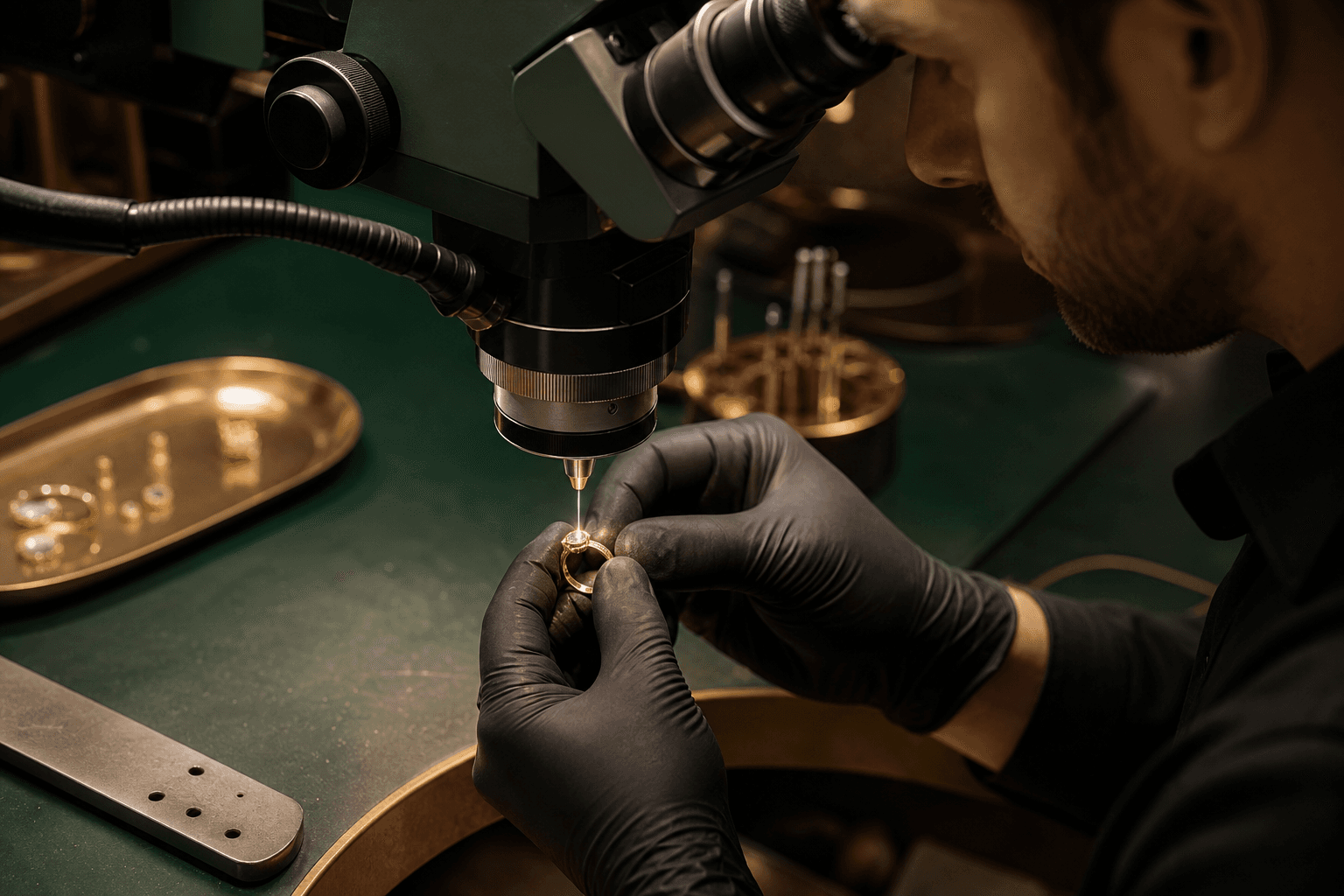
Laser welding joins jewelry with a tightly focused beam that melts a small area of metal, allowing precise work with less surrounding heat than many conventional joining methods. It can help with fine repairs, rebuilding worn areas, and fabrication, but success depends on the metal, joint fit, access, finish, stones, and the operator’s process choices. It is not automatically better than soldering.
What laser welding actually does
A jewelry laser welder directs concentrated light at a prepared joint. The beam creates a small molten pool, which cools into a metal connection as the operator moves along the seam or applies controlled spots. Filler wire may be added when the joint needs extra material, while autogenous welding joins the parts without separately fed filler.
The central advantage is localized heat. Less surrounding metal may be disturbed than with a broader heat source, which can help preserve nearby detail, finishes, or delicate construction. That precision also creates a limitation: the parts must be aligned closely and held steadily, because a laser does not compensate for every large or uneven gap.
Laser welding is a family of processes, not one universal setting. The National Research Council of Canada identifies autogenous, wire-fed, hybrid, pulse, continuous, oscillation, and double-spot approaches, along with low heat input and strict fit-up as relevant advantages and limitations. NRC material on laser-welding approaches provides useful context for that balance.
The main laser welding techniques used in jewelry work

The technique selected changes how deeply the metal melts, how broadly heat spreads, whether filler is needed, and how forgiving the joint is. A jeweller chooses the approach after examining the alloy, thickness, access, gap, and surrounding construction.
| Technique or approach | What it changes | Practical implication |
|---|---|---|
| Conduction mode | Creates a shallower, more surface-focused melt with heat conducted into surrounding metal. | Useful for controlled surface joining or delicate work where deep penetration is unnecessary, subject to the joint and material. |
| Keyhole mode | Uses a more intense beam interaction to create deeper penetration. | Can reach deeper into a joint, but demands careful control of thickness, alignment, and heat effects. |
| Pulse operation | Delivers energy in separate bursts rather than one uninterrupted beam. | Gives the operator discrete points of control and time between pulses for heat management. |
| Continuous operation | Maintains a sustained weld as the operator travels along a seam. | Can suit a longer, consistent joint when the workpiece and heat path support it. |
| Autogenous welding | Joins parent metals without separately fed filler. | Requires a well-matched, closely fitted joint because there is no added metal to bridge a gap. |
| Wire-fed welding | Adds compatible filler material to the molten pool. | Can rebuild a worn edge or help fill a prepared joint, while adding material and finishing considerations. |
| Oscillation or spot strategies | Changes how energy is distributed across a point or small area. | Can affect bead shape, coverage, and heat distribution without making the process suitable for every construction. |
These categories describe process choices, not instructions for operating equipment. The NRC also identifies laser welding among the technologies used in aluminium transformation, showing that the underlying process extends beyond precious-metal jewelry, but the correct approach still depends on the specific material and joint. NRC information on laser welding technologies offers that broader technical perspective.
Where laser welding can help in jewelry repair and fabrication
Laser welding may suit a localized seam, a small split, a worn edge, or a component that needs carefully controlled material added back. It can also be considered for custom fabrication where two accurately prepared metal parts need a narrow, controlled join.
- Seam repair: A fine crack or split may be approached with a sequence of small welds after the damage is cleaned and aligned.
- Rebuilding worn areas: Compatible filler can sometimes restore material at an edge, prong, hinge area, or other worn feature before shaping and polishing.
- Closing a small gap: A closely controlled joint may be welded when the parts can be brought into suitable alignment.
- Delicate components: Localized energy may help limit heat spread around fine details, although the surrounding metal and finish still require inspection.
- Custom fabrication: Precisely prepared components can be joined during fabrication when the chosen alloy, thickness, and geometry support the process.
These are potential applications, not a promise that every repair provider offers laser work or that every piece is suitable. A jeweller must inspect the actual item before choosing a joining method.
Gold, silver, and stones: why the material changes the technique
Laser welding does not behave identically on every jewelry metal. Reflectivity, thermal conductivity, alloy composition, thickness, contamination, plating, and joint geometry all affect how the beam interacts with the workpiece.
Silver can be technically demanding because it reflects laser energy efficiently and moves heat quickly through the metal. Gold alloys also vary in composition and colour, so the joint, filler, and final finish need to be considered together. A process that works well on one gold alloy or thickness is not a universal recommendation for another.
Plating adds another layer of preparation. The surface may need to be removed or managed around the joint, and the repaired area may require polishing, refinishing, or replating afterward. Solder from an earlier repair, enamel, hollow construction, hidden voids, or severe thinning can also change the risk and available options.
Mounted stones require particular care. A stone may be affected by heat, reflected energy, movement, existing fractures, or a setting that is already loose. Laser welding can sometimes be considered near a gemstone, but only after the setting, stone, metal, and access have been assessed by a trained operator. Heat and beam exposure must be controlled by trained personnel, especially when the construction or stone condition is unknown.
Laser welding versus soldering: choose by the joint, not the label
Laser welding and soldering are different joining methods, and neither is automatically superior. The better choice depends on the condition of the piece, the size and geometry of the joint, the surrounding materials, and the finish required afterward.
| Decision factor | Laser welding | Soldering |
|---|---|---|
| Heat spread | Usually concentrated around the weld area. | Uses a broader heat path to bring the joint and solder to working temperature. |
| Filler | May be autogenous or use a small amount of compatible wire. | Relies on solder flowing into the prepared joint. |
| Gap tolerance | Often favours close, accurately aligned parts. | Can be more forgiving when a suitable joint needs solder to flow across a small gap. |
| Access | Needs a clear line of sight and room to position the work securely. | May suit construction where broader access for heat and solder is available. |
| Finish disturbance | May limit disturbance outside the immediate weld area, though finishing is still common. | Can affect a wider area and may require more cleanup or refinishing. |
| Equipment and skill | Requires specialized equipment, controlled conditions, and trained operation. | Requires appropriate tools, alloy knowledge, heat control, and soldering skill. |
| Typical fit | A precise, localized joint where the parts can be closely prepared. | A joint that benefits from broader filler flow or a traditional construction approach. |
A larger gap, distorted construction, or a joint designed around solder flow may favour soldering. A small, clearly accessible joint with valuable detail close by may invite consideration of laser welding. The provider should explain the reasoning instead of presenting one technique as universally better.
A practical decision guide for a repair or custom piece

Use the following rules as a conversation starter, not as a remote diagnosis.
- Consider laser welding when the damage is localized, the metal can be aligned accurately, the operator has clear access, and limiting heat spread is a meaningful concern.
- Ask about soldering when the gap is larger, the construction benefits from broad filler flow, or the original piece was built around soldered joins.
- Pause for inspection when stones, plating, enamel, unknown alloys, hollow areas, previous repairs, severe thinning, or structural distortion are involved.
- Ask about another repair plan when the damaged area is part of a larger failure. Joining one visible crack may not restore the strength of the surrounding structure.
Hypothetical example: a fine gold seam near a stone
Imagine a fine gold seam opening beside a mounted stone. A provider may consider laser welding because the damage is localized and a narrow heat path could help limit disturbance around the setting. Before approving it, the provider would still need to check the alloy, stone security, seam alignment, access, and whether the setting has hidden damage.
Hypothetical example: a worn silver component
Now imagine a thin silver loop that has worn nearly through after repeated movement. Laser welding may be technically possible, but fast heat transfer, limited remaining thickness, and the need to rebuild the shape could make the repair more complex. The right decision may involve adding compatible material, replacing the component, or using another joining method after inspection.
What Ontario workplace safety adds to the conversation
In Ontario, workplace laser use falls under the Occupational Health and Safety Act. Employers must take every precaution reasonable in the circumstances, provide training on safe laser use, and appoint a competent person where required. Ontario’s workplace laser-safety guidance explains these general duties.
Laser welding and related welding processes can produce visible or invisible radiation, so appropriate eye protection is essential. The federal welding hazard guide also identifies eye and face protection as necessary controls for welding radiation. Canada’s welding hazard-control guidance provides the relevant safety context.
Workplace duties are separate from product regulation. Health Canada’s guidance covers laser products sold, leased, or imported into Canada, including products brought in for use, processing, or service. Health Canada’s scope for laser-product regulations explains that distinction.
The word laser also appears in unrelated applications, such as laser lighting ideas for events. Event lighting equipment should not be treated as jewelry-welding equipment or as evidence that a provider has the training and controls required for welding work.
Questions to ask before approving laser work
A clear provider should be able to explain the proposed process in terms that match the actual piece. Ask these questions before authorizing work:
- What exactly is damaged, and is the visible problem connected to a deeper structural issue?
- What metal and alloy are present, and how were they identified?
- How will the joint be cleaned, prepared, aligned, and held?
- Will the weld be autogenous, or will compatible filler be added?
- Are stones, plating, solder, enamel, hollow areas, or previous repairs close to the work?
- What access does the operator have, and what areas cannot be reached directly?
- What polishing, reshaping, refinishing, or replating will follow?
- How will the completed joint and nearby setting be inspected?
- What limitations or possible damage cannot be ruled out before opening or cleaning the piece?
- Who is responsible if hidden damage, incompatible alloy, or a previous repair changes the result?
When the technique is not enough to make the decision
A photograph rarely confirms alloy, wall thickness, stone security, internal voids, or the quality of an earlier repair. Even a detailed explanation of laser welding cannot establish whether a particular ring, necklace, earring, or custom component should be welded without physical inspection.
If you are preparing a new custom project, write down the intended use, metal preference, stone choice, dimensions, finish, and any known sensitivities before discussing fabrication. You can also review this custom jewelry design preparation guide.
For an existing sterling-silver piece, document tarnish, scratches, loose components, plating, and prior repairs before selecting a cleaning or repair route. The advice in this sterling silver jewelry cleaning guide can help you separate routine surface care from a condition that needs inspection.
Frequently asked questions
Can laser welding repair jewelry near gemstones?
Sometimes, but proximity alone does not establish suitability. The operator needs to assess the stone, setting, alloy, access, existing heat damage, and proposed heat path before deciding whether laser welding is appropriate.
Is laser welding always better than soldering for jewelry?
No. Laser welding may suit a precise, localized joint with close fit-up, while soldering may be more practical for a larger gap, traditional construction, or a joint designed for solder flow. The condition and geometry of the piece should determine the method.
What should I ask before approving laser welding on a piece?
Ask what is damaged, which alloy is present, how the joint will be prepared, whether filler is needed, what risks exist near stones or plating, what finishing follows, how the result will be inspected, and what limitations remain.
Does laser welding work the same way on gold and silver?
No. Gold and silver alloys differ in reflectivity, heat movement, composition, thickness, and finishing behaviour. Silver can be particularly demanding because it reflects laser energy and conducts heat quickly, so the process must be assessed for the specific piece.
Is jewelry laser welding safe in an Ontario workplace?
It can be performed only within appropriate workplace controls. Ontario requires reasonable precautions, training, and competent-person responsibilities where required, while welding guidance identifies the need for suitable eye protection against visible and invisible radiation.
For a new personalized piece, Advikosh offers custom jewelry design and fabrication. Discuss the design, materials, stones, finish, and care requirements directly, without assuming that laser welding is included.