

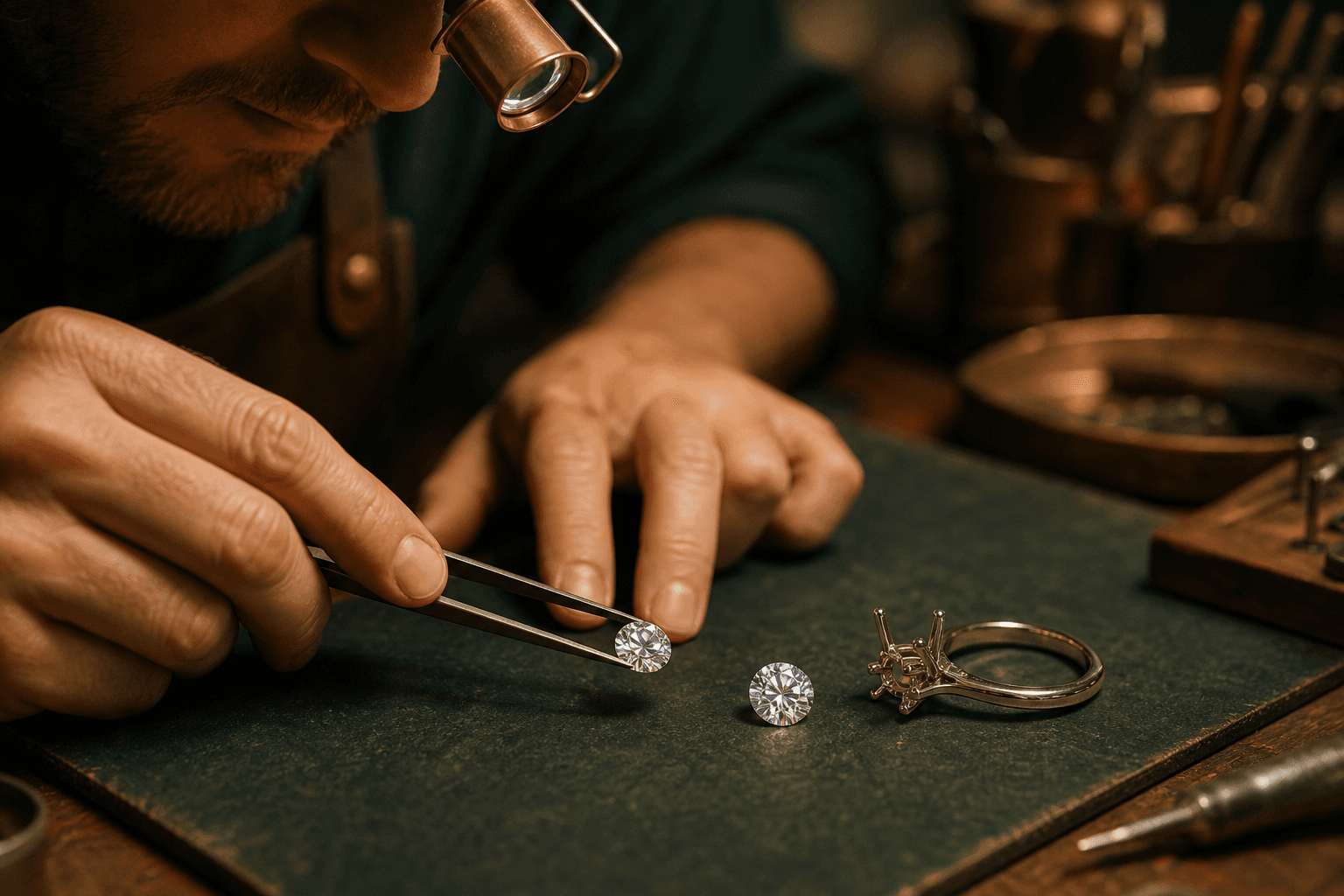
For an engagement ring, choose moissanite if you want a distinct gemstone with strong sparkle, visible presence, and more flexibility in the overall ring budget. Choose a lab-grown or natural diamond if the centre stone must be a diamond and its identity, origin, or diamond-specific documentation matters most.
Start with the stone’s identity
Moissanite and diamond are different gemstones, even though both can be used in engagement rings. Moissanite is made from silicon carbide. A natural diamond forms in the Earth, while a lab-grown diamond is created in a controlled environment but has the same diamond identity and crystal composition as a mined diamond.
That distinction matters because “diamond alternative” does not mean “lab-grown diamond.” An engagement-ring listing should name the centre stone accurately, so you know what you are buying, what documentation applies, and which visual characteristics to expect.
| Stone | What it is | Origin | Engagement-ring priority |
|---|---|---|---|
| Moissanite | Silicon-carbide gemstone | Usually laboratory-created for jewellery | Distinct gemstone identity, strong sparkle, visual size, and budget flexibility |
| Natural diamond | Diamond with a carbon crystal structure | Formed naturally in the Earth | Natural origin, traditional expectations, and diamond-specific grading documentation |
| Lab-grown diamond | Diamond with the same essential identity as a natural diamond | Created in a laboratory | Diamond identity with a laboratory origin and different purchasing priorities from a mined stone |
Choose by the meaning you want the ring to carry
The best engagement-ring stone is the one that matches your non-negotiable. Moissanite can provide a prominent centre stone for less than a comparable diamond, while a natural or lab-grown diamond offers the identity and grading language that some couples consider essential.
- Choose moissanite if you value a distinct gemstone, lively sparkle, a larger-looking centre stone, and flexibility to spend more on the setting or keep the total ring cost lower.
- Choose lab-grown diamond if you want a diamond and are comfortable with laboratory origin.
- Choose natural diamond if geological origin, traditional expectations, or a natural-diamond grading report is part of the ring’s meaning for you.
State that priority before comparing individual rings. It prevents a lower price, larger face-up size, or brighter photograph from deciding a question that is really about identity.
Appearance: brilliance, fire, colour, and size

Moissanite often appeals to buyers who want noticeable sparkle and coloured flashes, while diamond appeals to those who prefer its familiar light performance and established grading vocabulary. Neither stone looks identical in every cut, lighting condition, or engagement-ring setting, so photographs alone are a weak basis for a final decision.
Brilliance and fire are not the same thing
Brilliance describes the white light returned from a stone. Fire describes flashes of spectral colour. Moissanite can show pronounced fire, particularly in larger stones or under direct lighting, while a well-cut diamond is often chosen for a balanced, classic sparkle.
Cut quality, facet pattern, proportions, colour, and the surrounding metal all affect what you see. A round stone in a bright setting can appear more animated than a lower-profile shape, and two stones with the same stated size can look different once mounted.
If you are still comparing the visual language used for these stones, this educational comparison of moissanite versus diamonds offers another useful perspective before you judge an engagement-ring listing by its photographs.
Colour and visual size
Moissanite is available in different colour appearances, and diamond listings commonly use colour grades. Ask what the description means for the actual stone rather than assuming that a colour term has the same meaning across both categories.
Moissanite can also give you more visible size for a similar stone budget. That does not automatically make it the better engagement-ring choice. If you want the symbolism and identity of a diamond, a smaller diamond can be more satisfying than a larger stone whose identity does not match your expectations.
Durability and everyday wear
For an engagement ring worn every day, diamond has the higher scratch resistance, while moissanite is also a durable jewellery stone with a Mohs hardness of about 9.25. The practical winner depends on the stone, its setting, how often you wear it, and the impacts it receives, not on hardness alone.
Hardness measures resistance to scratching. Toughness describes how well a stone resists chipping or breaking under impact. A high hardness rating does not make either stone immune to damage, and a secure setting remains essential for a ring worn through daily activities.
Choose a protective setting if your ring will encounter frequent knocks, tools, sports, or manual work. Prongs, bezels, stone height, and the condition of the band affect the complete ring, so compare the setting as carefully as the centre stone.
Cost and value: compare the complete engagement ring
There is no useful single “average price of moissanite” that applies to every engagement ring. A complete CAD price changes with the stone’s dimensions and cut, the metal, setting complexity, accent stones, documentation, custom fabrication, taxes, shipping, and the seller’s return terms.
Moissanite generally costs less than a comparable diamond because you are paying for a different gemstone with a different supply chain and grading context. The difference between two finished rings can still be narrowed or widened by the ring design, metal weight, workmanship, and custom requirements.
Use this engagement-ring cost breakdown
- Centre stone: Confirm the stone identity, shape, dimensions, colour description, and whether any “equivalent” size is only a face-up comparison.
- Metal: Check whether the ring uses sterling silver, gold, platinum, brass, or another material, and confirm purity or finish wording where applicable.
- Setting: Compare the setting style, accent stones, prong or bezel construction, band width, and design details that affect labour and daily wear.
- Documentation: Ask what report, certificate, identification card, or seller documentation is included, and what it actually verifies.
- Order total: Add taxes, shipping, custom work, resizing or alteration terms if offered, and any restrictions on returns or exchanges.
The useful comparison is between complete rings with similar stone dimensions, metal, setting quality, and order terms. A stone-only price cannot tell you whether one engagement ring represents better value for your priorities.
Custom or ready-made: which engagement-ring route fits?

Ready-made jewellery is usually simpler when you already like the proportions and want to compare a defined piece. Custom work makes more sense when available designs do not solve your size, style, symbolism, or material requirements.
Choose a ready-made ring when the proportions already work
A ready-made ring suits you when the centre-stone shape, band width, setting height, metal, and overall style already match the wearer. It also gives you a defined piece to assess rather than asking you to make several design decisions at once.
Choose custom work when the design itself is personal
Custom work suits you when you want a particular stone identity, setting, metal combination, proportion, or symbolic detail. Prepare the approximate stone dimensions, preferred metal, setting style, budget ceiling, ring size, and intended wear before requesting a design discussion. This custom jewellery preparation guide can help you turn those preferences into a clearer brief.
Custom moissanite ring or traditional diamond ring?
If you want an engagement ring built around a particular size, setting, metal, or personal detail, a custom moissanite ring gives you more freedom to allocate the budget across the whole design. A traditional diamond ring is the clearer choice when the centre stone must be a natural or lab-grown diamond and its identity is non-negotiable.
What to verify before buying an engagement ring online in Canada
Before paying, confirm the stone identity, dimensions, metal, setting, documentation, full CAD total, delivery terms, return policy, and care instructions in writing. Ontario guidance says online sellers must provide accurate information about the goods and an itemized price list before purchase, and businesses must not misrepresent a product’s grade, style, model, or quality. Ontario’s safe-online-shopping guidance and its consumer-protection guidance explain these expectations in more detail.
- Stone identity and size: Is it moissanite, natural diamond, lab-grown diamond, or another stone? Are measurements supplied in millimetres?
- Metal and finish: What is the base metal, purity, plating, or surface finish? Does the description match the photos?
- Setting and construction: How is the centre stone held, and are accent stones or design features included in the quoted ring?
- Documentation: What document comes with the ring, who issues it, and which facts does it confirm?
- Total price: Is the amount in CAD? Are taxes, shipping, custom design charges, or other costs separate?
- Timing: Is the ring ready to ship or made after ordering? What delivery window applies to a custom piece?
- Returns and exchanges: Are custom pieces treated differently from ready-made jewellery? Are there condition or timing requirements?
- Care: What cleaning method, storage, and wear limits apply to the stone, metal, and finish together?
Care and the cubic zirconia comparison
Clean moissanite jewellery gently with lukewarm water, a small amount of mild soap, and a soft brush, then rinse and dry it with a soft, lint-free cloth. Remove the piece before activities that expose it to hard impacts, heavy abrasion, or substances that could affect the metal or finish.
Harsh chemicals, abrasive cleaners, and unsuitable ultrasonic or steam methods can damage a setting, plating, or mixed-material design, so use the care method appropriate for the complete ring. This matters especially when moissanite is combined with pearls, plated metal, or delicate details.
| Feature | Moissanite | Cubic zirconia |
|---|---|---|
| Identity | Silicon-carbide gemstone | Lab-created zirconium-dioxide material |
| Hardness | About 9.25 on the Mohs scale | About 8.5 on the Mohs scale |
| Visual character | Strong brilliance with noticeable fire in many cuts | Bright appearance that can suit lower-cost fashion jewellery |
| Typical buying expectation | Longer-term fine-jewellery use with a defined gemstone identity | Lower-cost style or occasional-wear jewellery |
Moissanite is therefore not simply “better cubic zirconia,” and neither stone is a diamond. If you want a durable centre stone for frequent wear, compare moissanite with diamond on identity, setting, documentation, and total ring quality instead of choosing by the word “simulant” alone.
Choose the stone that matches your non-negotiables
Ask yourself three questions: must the centre stone be diamond, which visual and budget trade-off feels right, and do you want a ready-made ring or a custom design? The answers usually narrow the decision faster than comparing isolated sparkle claims or stone-only prices.
Moissanite is a strong fit for a buyer who welcomes a distinct gemstone, visible presence, and budget flexibility. Lab-grown diamond fits a buyer who wants diamond identity with laboratory origin, while natural diamond fits someone for whom natural origin and traditional expectations are central.
If your preferred route is a personalised piece, Advikosh offers custom jewellery design under the promise “Your design, our craftsmanship.”