
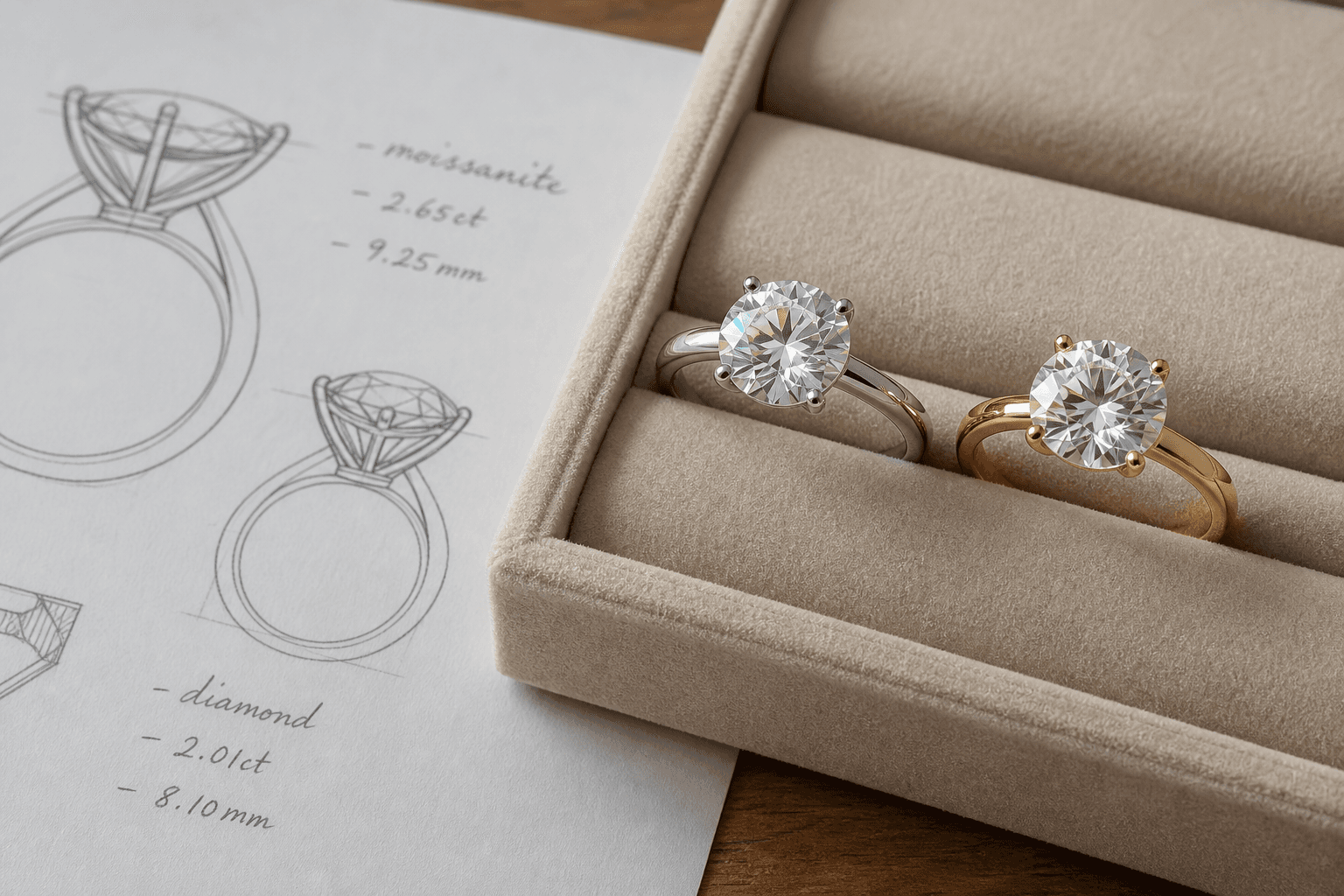
Moissanite can offer a lower upfront-cost route to an elegant fine-jewellery design, while a diamond may better suit someone who values traditional stone identity and ownership. The better choice depends on what you mean by value: purchase price, appearance, everyday wear, emotional significance, customization, service, or possible resale.
For Canadian buyers, the fairest comparison is not the loose-stone price alone. Compare two complete CAD quotes covering the stone, metal, setting, labour, documentation, taxes, shipping, returns, and future support. Neither moissanite nor diamond should be treated as a guaranteed investment.
Quick summary

- Moissanite may suit buyers focused on initial budget control, design flexibility, or a gemstone alternative.
- Diamond may suit buyers who specifically want traditional diamond identity and documentation.
- Compare complete finished-piece quotes, not only stone prices.
- Confirm the exact stone, dimensions, metal, setting, certification, approval process, timing, and service terms.
- Separate personal-use value from resale value. Future recovery is uncertain for either stone.
What does value mean in a jewellery purchase?
Value is the relationship between what you pay and what you receive. In a meaningful piece, that includes the visual result, stone identity, setting, materials, design significance, craftsmanship, and confidence in the purchase.
A lower-priced stone may allow a larger-looking design or a more substantial metal choice. However, if you specifically want a diamond, an alternative may not meet your expectations. Paying more for a diamond also does not automatically make it better value if its traditional identity is not important to you.
Resale is a separate question. A piece can be excellent value for the person who wears it without recovering its original purchase price later.
Moissanite vs diamond: the buying criteria that matter

| Criterion | Moissanite | Diamond |
|---|---|---|
| Upfront cost | May appeal to buyers managing initial spending. Compare the complete finished-piece quote. | May require a larger budget depending on the stone and design specifications. |
| Appearance | Offers a gemstone alternative to the traditional diamond look. | Fits buyers who specifically want the established identity of a diamond. |
| Stone identity | Should be identified clearly as moissanite in writing. | Confirm whether it is natural or lab-grown and request written details. |
| Customization | Can be considered in a custom design, subject to confirmation. | Can also be incorporated into a custom design, with the setting confirmed. |
| Documentation | Request applicable details and documentation for the individual stone. | Request applicable grading or certification documentation for the individual stone. |
| Resale | Do not assume a lower purchase price creates a resale advantage. | Do not assume the original price will be recovered. |
This is a decision framework, not a universal ranking. Exact specifications, craftsmanship, documentation, and policies affect the value of the finished piece.
Upfront cost: compare the complete CAD quote
When comparing moissanite vs diamond price, begin with two equivalent designs. Each quote should identify the stone type, dimensions, relevant quality details, metal, setting, design complexity, labour, certification or documentation, taxes, shipping, and included services.
Do not compare a loose moissanite price with a finished diamond ring. Two rings with similar apparent size can differ in metal weight, setting construction, workmanship, documentation, and customization. Advikosh’s catalogue presents CAD price ranges and filters for materials, stones, metals, and certifications, but a catalogue filter does not prove that every individual product includes every listed certification. Confirm the details of the exact piece.
Also ask whether the displayed amount is the final amount payable. Clarify taxes, shipping, import-related charges where relevant, and whether engraving, special sourcing, or customization fees are separate.
Appearance and stone identity
The key question is not simply which stone looks more expensive. Ask which appearance and identity you actually want to wear. Moissanite may suit someone comfortable choosing a gemstone alternative, while diamond may suit someone for whom traditional diamond identity is part of the meaning of the piece.
Product photographs help assess style, but they cannot confirm every detail of a custom order. Request the written stone description, dimensions, metal details, and available documentation before approving the design.
Durability, setting, and long-term wear
Long-term value depends on more than the centre stone. The setting, securing method, metal, dimensions, intended frequency of wear, and maintenance routine all matter. Discuss the complete design rather than judging either stone in isolation.
Ask how the piece should be cared for, whether inspections or repairs may be appropriate, and which services are available if the setting becomes loose or damaged. Advikosh’s custom-design guidance recommends confirming materials, dimensions, production details, shipping, returns, exchanges, and support before ordering.
Documentation and certification: what to confirm
Documentation helps verify what you are buying, but the relevant document depends on the stone and individual piece. Ask for the exact stone identity, dimensions, quality description, and any certificate or report included with the order.
If certification matters to your decision, confirm who issued it and whether it applies to the specific stone. Ask for the agreed documentation to appear in the quote or order confirmation, along with the metal and setting details.
Customization can change the value calculation
A custom design makes the comparison more personal and more detailed. The stone is only one decision among the metal, dimensions, setting, finish, proportions, symbolism, and overall construction. Moissanite may leave more budget for another design feature, while diamond may be the non-negotiable element that makes the piece meaningful.
Advikosh offers custom jewellery and identifies gold, silver, platinum, and brass among the materials used for custom creations. Its guidance recommends confirming the final description, dimensions, materials, total CAD price, approval method, production timing, shipping, returns, exchanges, and support. These questions do not mean every material and stone combination is available for every design.
Before approving a custom order, provide the jewellery type, occasion, wearer, measurements, inspiration, preferred materials, approximate budget, desired delivery date, and details that must not change. Ask what can be revised and when approval becomes final.
Resale value: keep expectations realistic
When people ask about value, they may mean what they could recover by selling later. That is resale value, and it should be assessed separately from the value received while wearing and enjoying the jewellery.
Future resale can depend on stone identity, documentation, condition, metal, craftsmanship, design, market demand, and the eventual buyer. A diamond is not guaranteed to recover its original price, and moissanite should not be described as having a guaranteed resale outcome either.
If resale matters, retain the invoice, stone documentation, certificates, product details, and service records. No seller can guarantee a later selling price.
Returns, repairs, and service terms
Service terms belong in the value calculation because they affect your options after purchase. Confirm eligibility, deadlines, condition requirements, excluded charges, shipping responsibilities, and the process for reporting a problem.
Advikosh’s published policy describes eligible non-custom jewellery returns within 30 days of delivery, subject to conditions and inspection. It also states that customization, certification, engraving, special sourcing, and other special-service charges may be excluded from refunds. Custom jewellery can therefore carry different practical risk from a ready-to-ship piece. Read the policy applying to your exact order before paying.
Which choice fits your priorities?
Choose moissanite when budget control leads
Moissanite may fit when you want to limit initial spending, consider a gemstone alternative, or direct more of the budget towards the setting, metal, or design. Confirm the complete quote so the advantage is based on comparable finished pieces.
Choose diamond when traditional identity is essential
Diamond may fit when its traditional identity is central to the proposal, gift, or personal meaning. If you would continue wondering whether you should have chosen a diamond, the lower initial price of another option may not represent good personal value.
Choose based on customization when design matters most
Compare how each stone works with the proposed setting, dimensions, metal, and budget. Ask the jeweller to confirm the exact combination rather than assuming every listed stone and material can be used together.
Custom jewellery quote checklist
- Stone identity, dimensions, and relevant quality specifications.
- Whether the stone is moissanite, natural diamond, or lab-grown diamond.
- Applicable certificate, report, or documentation for the individual stone.
- Metal, setting, dimensions, finish, and design details.
- Labour, customization, certification, engraving, sourcing, and other charges.
- Total CAD price, taxes, shipping, and other amounts payable.
- Approval method, revision limits, production timing, and delivery expectations.
- Return and exchange eligibility, exclusions, deadlines, and shipping responsibilities.
- Available repairs, finishing services, support, and records to retain.
Frequently asked questions
Does moissanite have resale value?
It may, but the amount and ease of resale are uncertain. Documentation, condition, design, materials, market demand, and the eventual buyer can all affect the outcome. Do not treat it as a guaranteed investment.
Is a diamond automatically better value than moissanite?
No. Diamond may be better value for someone who specifically wants traditional diamond identity. Moissanite may be better value for someone prioritizing initial budget control, design flexibility, or a gemstone alternative.
What should a custom moissanite or diamond quote include?
It should identify the stone, dimensions, quality details, metal, setting, design, labour, documentation, total CAD price, taxes, shipping, approval process, timing, returns, exchanges, and support.
Do return rules differ for custom jewellery?
They can. Customization and special-service charges may be excluded from refunds, and non-custom return conditions may not apply. Advikosh’s published policy describes eligible non-custom returns within 30 days of delivery, subject to conditions and deductions. Confirm the terms for your exact order.
Make the choice based on the value you actually want
Decide whether your priority is a lower initial spend, traditional diamond identity, a particular visual result, custom flexibility, or long-term service confidence. Then compare equivalent complete CAD quotes, written stone details, documentation, and the applicable return terms.
Purchase price, personal-use value, and resale value are different questions. Choose the option that answers your priority clearly, and treat any future resale outcome as uncertain.
For Canadian shoppers exploring ready-to-buy pieces or a custom design, Advikosh offers online jewellery collections and custom jewellery options involving moissanite, diamonds, and other fine-jewellery materials.