



Quick summary: what this checklist will do for you
This article gives a focused seven-item decision checklist to use before you commission custom jewelry. Each numbered item explains the choice you must make, why it matters, and one practical next step. If you are buying from a Canadian online jeweller check that pricing is shown in CAD and that store policies cover shipping, returns and support, as these reduce ordering friction and unexpected costs. For a typical consultation workflow see StoneBridge's pre-order and aftercare checklist linked below.
1. Confirm the purpose and non-negotiables
Start by naming the primary purpose of the piece: daily wear, engagement, heirloom, or a gift. Then separate true non-negotiables that will drive materials and construction from flexible style preferences. Non-negotiables usually include product type, durability needs for everyday wear, metal allergies, and whether a specific gemstone identity is required.
Why this matters: clear non-negotiables let a maker quote and specify correctly, which reduces surprises and scope changes. Best-practice guides recommend treating your visual reference and the production specification as two distinct layers so inspiration does not replace technical decisions that affect cost and longevity, as Belaroq explains in its buying guide.
Practical next step: write a one-line brief for the jeweller that lists purpose and your three non-negotiables. Example brief: "Engagement ring, must be platinum or palladium, centre stone must be a conflict-free diamond, low profile setting for daily wear." Attach any reference images with the brief and send them with your first query.
2. Set a clear budget and rank priorities
Decide a firm budget range before design work begins and rank what matters most inside that budget. Break the budget into three buckets: metal, gemstone, and labour or design. Ranking priorities makes trade-offs easier, for example choosing a slightly lower carat weight to get better cut quality, or prioritizing a handcrafted setting over an expensive centre stone.
Why this matters: a defined budget reduces scope creep and helps the jeweller propose feasible options. Multiple design checklists urge buyers to clarify vision and budget up front because it simplifies every other choice and speeds the process, as covered by Eternal Carat and other specialist sources.
Practical next step: tell the jeweller your top three priorities in one sentence. Example script: "My budget is $X to $Y CAD. Priorities are 1) gemstone cut and durability, 2) low-profile setting for daily wear, 3) handcrafted finish rather than machine finish."
3. Choose metals and gemstones and confirm identity

Pick the metal first, for example 14K or 18K gold, sterling silver, or platinum, and decide if you want solid alloy, gold-filled, or vermeil. For stones, decide whether you prefer natural diamonds, moissanite, pearls, or another alternative. For mounted gemstones request identity, dimensions, and any available lab reports before production.
What to verify: ask whether the seller will provide gemstone reports or independent lab certificates, what the metal alloy composition and hallmark will be, and whether pearls are natural, cultured, or treated. Belaroq's guidance on separating must-haves from preferences and Rosec Jewels' production checklist both highlight stone identity and dimensions as approval items buyers should confirm before production.
Practical next step: request a written specification that lists the metal alloy, expected hallmark, exact gemstone type, and dimensions in millimetres. If you require a certificate, ask whether the jeweller will include it or whether you must pay for an independent report.
4. Lock down measurements, ring size and length tolerances
Measurements are production-critical. Confirm ring size including seasonal or style variation allowances, chain length and clasp type, and mounting height for comfort and catch risk. If a design uses multiple stones, provide measurements or acceptable tolerances for each seat so the maker can plan prongs and bezels correctly.
Why this matters: remaking or resizing after production is the most common cause of delay and extra cost. Consultation checklists for both online and in-store custom orders emphasise measuring and documenting tolerances before the order proceeds, as StoneBridge and Rivansh note.
Practical next step: measure and record ring size using a professional sizer or a printable sizing guide, choose the exact chain length you want, and include a note such as "allow plus 0.5 mm ring tolerance for comfort" if you want a specific wiggle room. Send these measurements with your approval email.
5. Require CADs, prototypes and an explicit approval step
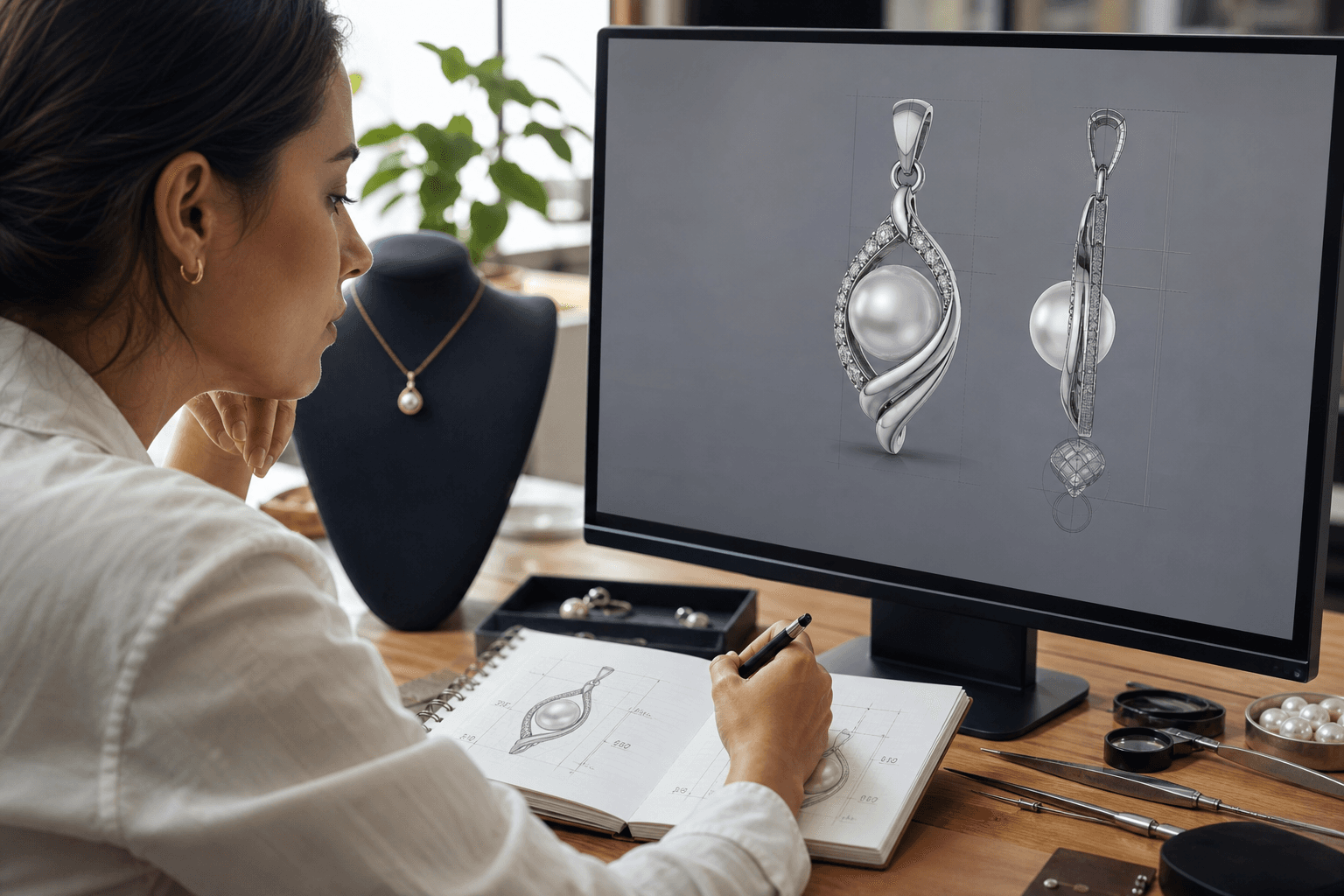
Insist on seeing a digital CAD and, for complex or high-value pieces, a 3D printed resin prototype before production. A CAD is not optional for bespoke work because it shows scale, stone seats, prong geometry, and engraving placement. Check the CAD for dimensions, stone orientation, prong thickness, and any text or hallmarks.
Set a clear approval workflow: request revisions, confirm the final CAD in writing, and require the workshop to begin only after you provide a signed approval. Rosec Jewels and other custom workflow guides list CAD and prototype approval as a standard production checkpoint to avoid costly remakes.
Practical next step: ask the jeweller to supply a checklist of CAD checks they will perform and provide one of your own, for example: "Confirm centre stone seat diameter, check prong clearance, verify total finished height, note engraving text exactly." Reply with "Approved to produce" only after you are satisfied with the CAD or prototype.
6. Agree timelines, final price and the change-order policy
Clarify the expected production timeline, deposit and final payment schedule, and how change orders are priced. Ask whether timelines are estimated or guaranteed and what happens if the workshop needs extra time due to stone sourcing. Request an itemised written quote that shows how labour, metal and stones are priced separately.
Why this matters: bespoke manufacturing can be delayed by stone availability or bench scheduling. Buying guides recommend getting all pricing and timeline terms in writing before production starts so there is clarity about refunds, cancellations and additional charges for changes, as Eternal Carat and Belaroq explain.
Practical next step: ask for a simple contract clause such as this example to include in your written agreement: "Estimated finish date, deposit X% now, final balance due on delivery, change orders billed at cost plus labour. If production is delayed more than Y days, buyer may request a partial refund or cancellation." If the seller cannot provide reasonable change-order terms, consider alternatives.
7. Confirm shipping, inspection, returns and aftercare

Before you commit, confirm the seller's shipping method, insurance, and return or exchange policy for custom orders. For Canadian buyers check whether prices are shown in CAD, whether free shipping applies, and how cross-border duties are handled if any part of production or shipping crosses a border. Some Canadian retailers publish free shipping and a short free return window for added reassurance.
Inspect on delivery with a short quality checklist. Procurement guidance recommends stone security checks, polish and surface finish inspections, counts of detachable parts, and packing inspection to reduce returns and shipment claims, as TGST outlines. Use this inspection checklist on delivery:
- Visual check for chips, scratches, or polish issues
- Confirm stones sit securely and prongs are even
- Verify hallmarks, metal stamp, and any engravings
- Count detachable parts such as earring backs or safety catches
- Confirm any included certificates or paperwork are present
Practical next step: photograph the piece immediately in good light before opening the box and again after removing it. If you need to report a problem, include those photos with your message and refer to the agreed return window and inspection checklist.
Quick email template to request CADs, reports and timelines from a jeweller
Hi [Name],
Thanks for the quote. Before we proceed I need the following to approve production:
- Final CAD or 3D prototype for review
- Written spec listing metal alloy, hallmarks, and stone dimensions
- Any available gemstone reports or certificates
- Firm estimated finish date and deposit schedule
Please send these items and I will review within three business days. Thanks, [Your name]
Frequently asked questions
How long does a typical custom jewelry order take and how should I plan timing?
Timelines vary with complexity, stone sourcing and current workshop load. Simple adjustments and small pieces may take a few weeks, while complex or high-value commissions may take several months. Ask the maker for an estimated finish date and whether that date is guaranteed or an estimate. If you have a deadline, make this the first item in your brief and confirm it in writing with any penalties for missed delivery.
Can I return or exchange custom jewelry if I change my mind after production starts?
Return rights for bespoke pieces vary. Many sellers will accept cancellations before production begins but not after. Some Canadian retailers offer limited return or exchange windows for custom orders if specified in their terms. Always get the change and cancellation policy in writing before you pay a deposit.
What documentation should I ask for to verify gemstones and metal purity?
Ask for any available lab reports for diamonds or gemstones and a written metal specification that lists alloy content and expected hallmarks. If you need an independent report, confirm whether the jeweller will arrange it and who pays. If the seller cannot provide basic documentation, ask why and consider a different provider.
How do I approve a CAD or prototype and what if I need changes after I sign off?
Review CADs against your measurements and the checklist items you agreed. Approve in writing with a clear statement such as "Approved for production." After signing, changes typically incur additional cost and delay. If you anticipate likely revisions, negotiate one or two revision rounds into the agreement before work starts.
Further reading and sources
Belaroq custom jewelry buying guide: Custom Jewelry Buying Guide | Belaroq
StoneBridge consultation checklist: Custom Jewelry Consultation Checklist | StoneBridge Jewelry
Rosec Jewels production checklist: Custom Jewelry Process: How Your Dream Piece Comes to Life from Design – Rosec Jewels
Eternal Carat design checklist: Custom jewelry design checklist: create your dream piece – Eternal Carat
Rivansh buying guide: Custom Jewellery Buying Guide: Cost, Ring Size & 925 Silver – Rivansh
TGST procurement checklist for quality inspection: Custom Luxury Jewelry: What Buyers Often Miss | TGST Co.
Final call to action
If you are ready to start a custom consultation, Advikosh offers a "Your design, our craftsmanship" custom jewelry service with free shipping and responsive support. Book a consultation at the official website.
Talk with Advikosh
Contact Advikosh to ask about the next step and confirm which options fit your needs.